Because experience matters...

UAM knows aircraft disassembly.

We know the secrets of aircraft afterlife... and we're going to share a few with you.
www.uaminc.com


Thursday, April 7, 2011

First 747-400 Arrival to New Tupelo Facility


You’ve probably heard by now, UAM opened its widebody aircraft disassembly facility in Tupelo (MS) last month.

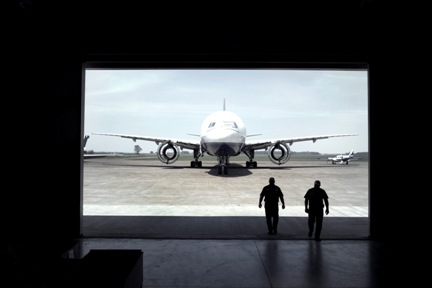
As part of the commencement event, UAM landed a  Japan Airlines 747-400 at the Tupelo Regional Airport for disassembly, complete with a low pass fly-by and tour of the aircraft for event attendees.

As an interesting insight to Japanese culture, the photos below illustrate the ground crew’s attention to detail and commitment to service on farewell flight for  N897DB.


Monday, February 28, 2011

More Aircraft Recycling

Who knew a fuselage has resale value?  UAM recently sold the better section of an MD87 fuselage, for testing and modification of the cargo fire suppressor system.  Here the illustrated version of the process – it’s pretty amazing…


First the disassembly team removed the tail
After removing the wings, the fuselage was cut from the cockpit and lower into the cradle  
Finally, the fuselage was secured into the cradle when is was loaded onto the truck for shipment

Monday, January 24, 2011


With the start of a new year, I reflect over the past year - since my arrival…  Retirement will do that…

It’s hard to believe there are over 35 aircraft in various stages of disassembly here at UAM.   I’ve witnessed the arrival of the a fellow wide-body A310, the 3rd in a series of A320s, the latest and greatest 747-400s and countless 737-Classics.  These arrivals in 2010, in addition to the existing projects, keep the disassembly teams busy – come rain, shine OR even snow.  Snow can be a bit of novelty here in the mid-south, often a good excuse to sit by the fire and drink hot cocoa – not these guys, they put hand warmers in their gloves and keep on working!  Plus the countless rainy days that don’t seem to discourage the mechanics at UAM.  
737 @ UAM Disassembly Facility

And I hear the  sales team works just as tirelessly to provide airlines around the world the inventory + component support required to keep fleets flying…

Thursday, December 16, 2010

A320 Landing Gears Removed...


So eventually my landing gear will go to a lucky new “in-service” aircraft, and I got a sneak peek at the process recently...  One of the A320-200 just went through landing gear removal.  The mechanics don’t remove the landing gears until they are sold, and the aircraft is positioned on the ramp for the "completion" phase of disassembly. During this process, the fuselage is lowered on cross-ties and the aircraft's parked permanently.  Now it’s much easier with the A320, since it has only three landing gears – Left MLG, Right MLG, Nose LG.   Those of us lucky wide-body 747s have 5 landing gears – 2 under each wing, rather than the standard narrow-body 1 per wing.  It was really something to see…  I tell you.

Sunday, November 14, 2010


stairwell to upper deck
Being a cargo aircraft, I had no idea the spacious interior of a passenger 747 – upper deck, lower deck, the works!  With the arrival of more 747-400 aircraft, I’ve gotten a peek at the interior and I was surprised to find a flight of stairs – a guy could get lost in one of those jumbo jets.  I’ve learned that originally the hump-like upper deck was used as a first class lounge area.  Currently, the upper deck provides additional passenger seating AND these jumbo jets can accommodate over 500 passengers total – just imagine all the beverage carts required for in-flight refreshments.
upper deck + cockpit
lower deck + in-flight entertainment

Friday, October 15, 2010

They call it BIG RED...

I am not sure if that's because we're in Arkansas Razorback SEC country, or if it's due to Big Red's size and color.  The new forklift is really quite useful - who knew?!  We may be retired to an aircraft disassembly facility, but there's a lot of construction - or perhaps we should say "deconstruction" - going on around here.

Big Red carefully moves this aircraft - AMAZING!

Big Red moves engines, cross-ties and even fuselages ready for crushing.  There seems be nothing this forklift can't do to help the team.  It even tackles hard to reach areas on the "jumbo jets" - like me.

Wednesday, September 29, 2010

I didn't know I had an IPC...

That’s right an Illustrated Parts Catalogue. It’s published by the company that designed and manufactures the aircraft. All the Boeing aircraft – 737, 747, 757, 767, 777, etc – have a specific IPC authorized by Boeing. The same with Airbus, Embraer, Bombardier and every other aircraft manufacturer.

These catalogs play an essential role in quality control and component identification. Here’s how it works, from my view of the process…

Every component that goes through inventory is identified and tagged by an A&P mechanic. Then, it’s verified by a Quality Control Specialist who checks to make sure the tag matches the identification plate and that the part number formatting is consistent. The IPC enters the inventory process as a necessity when the part manufacturer’s part number is missing.

Quality Control Specialists

The IPC (which is specific to its aircraft type) is referenced to “search” for the part by “system”. The knowledge and experience of the A&P mechanic is critical to this part of the process. If the mechanic can’t identify the part’s basic function – a “blind search and scour” ensues… often more than 500 pages of part illustrations and descriptions. Consider it an aircraft scavenger hunt”… Finally, the component is located in IPC. It’s identified with the IPC reference location is recorded on the tag. The Quality Control Specialist then re-verifies the correct IPC reference and part number, and checks that part number against the numbers used by the part’s manufacturer.

It’s exhausting just thinking about the process, but it all adds up to 100% accuracy + quality + customer satisfaction.

Inventory ID complete - units ready for warehouse